


Basal cell carcinoma (BCC) is the most common form of skin cancer diagnosed in the United States, and if you are reading this page, there is a good chance something on your skin has you concerned. Many of our patients have a parent, sibling, spouse, or friend who has had a BCC. One in five Americans will develop some form of skin cancer by age 70. Approximately 4 million new cases are diagnosed annually in the US.
Basal cell carcinoma is reliably treatable when caught early, and understanding what to look for, how it behaves, and what evaluation looks like can make a real difference in your outcome. If something on your skin is worrying you, we encourage you to call for details and schedule a skin evaluation.
You can also explore our provider publications to see the depth of clinical research behind the care we deliver.
What Basal Cell Carcinoma Actually Looks Like
One of the most common misconceptions we hear is that skin cancer always looks obviously alarming. In reality, basal cell carcinoma can be surprisingly subtle in its early stages, which is part of what makes awareness so important.
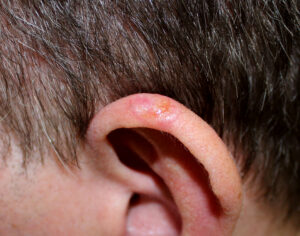
Basal cell carcinoma typically develops from prolonged or cumulative sun exposure, which is why it most often appears on sun-exposed areas: the face, ears, scalp, back, legs, neck, and hands. That said, it can also arise in areas that rarely see sunlight, so location alone is not a reliable rule-out. HMGS Dermatology providers have diagnosed BCCs in the groin, buttocks, armpits, and even on the feet.
Common Appearances to Know
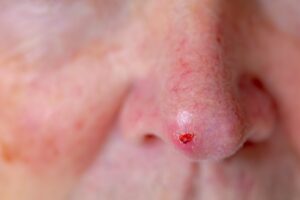
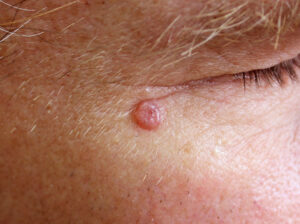
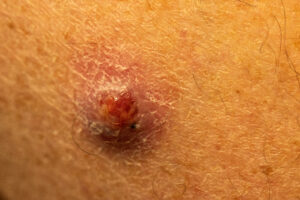
Basal cell carcinoma may present in several different ways. A pearly or waxy bump, often with visible blood vessels on its surface, is one of the most recognized presentations. Some lesions appear as a flat, flesh-colored or slightly pink scar-like area. Superficial BCCs might resemble eczema or irritated keratoses. Others look like a sore that heals and then reopens. A pink growth with slightly raised edges and a crusted center is another form HMGS Top Docs will recognize. Because these presentations overlap with benign conditions, a visual self-assessment is never a substitute for a professional evaluation.
Our board-certified dermatologists have extensive experience evaluating suspicious lesions across all skin tones and types. We have treated several generations of South Jersey families, and in that time, we have seen presentations that range from the textbook to the unexpected. Early evaluation is consistently the most important variable in a straightforward outcome. Learn more about what to expect from a professional mole check and skin evaluation.
How Basal Cell Carcinoma Is Diagnosed and Treated
If a dermatology provider identifies a lesion that warrants further investigation, the standard next step is a skin biopsy-often using the shave technique. HMGS providers sometimes use a punch biopsy to rule out morpheaform BCCs or a curette in hard to reach crevices of the ear. A small sample of tissue is taken and sent to a laboratory for analysis. Dermatopathology, the microscopic examination of skin tissue, confirms whether basal cell carcinoma is present and identifies its subtype. HMGS Dermatology has a Board Certified Dermatopathologist in house. Different subtypes of BCCs carry different growth patterns and may impact which treatment approach is most appropriate.
Treatment Options for Basal Cell Carcinoma
Several treatment approaches may be appropriate depending on the size, location, subtype, and depth of the lesion, as well as the individual patient’s health history and preferences.
Surgical destruction or excision, in which the lesion is destroyed or removed is a standard approach for many basal cell carcinomas. Mohs micrographic surgery may be recommended for lesions in cosmetically sensitive areas or those with a higher risk of recurrence. Mohs surgery allows for real-time margin assessment and tissue preservation, which is particularly valuable around the eyes, nose, and ears. Other options include topical medications (5-fluorouracil, imiquimod), photodynamic therapy, or radiation, depending on clinical circumstances. For advanced cases our team may prescribe targeted hedgehog inhibitors or refer to MD Anderson for immunotherapy.
Our practice encompasses medical, surgical, and dermatopathology expertise under one roof, which means the path from evaluation to diagnosis to treatment does not require referrals to unfamiliar providers. We work with two Mohs surgeons at Cooper Hospital to make sure care is streamlined and continuity is maintained. Patients dealing with related concerns, such as other forms of skin cancer or sun and actinic damage, can address all of those concerns within the same practice relationship. Individual treatment plans will always be determined by your provider based on your specific clinical picture.
Basal Cell Carcinoma Risk Factors and What You Can Do
Understanding your personal risk for basal cell carcinoma is one of the most useful things you can do for your long-term skin health. While anyone can develop this form of skin cancer, certain factors are associated with higher likelihood.
Who Is at Higher Risk
Fair skin, light eyes, and a history of frequent sunburns are among the most cited risk factors. Cumulative lifetime sun exposure matters significantly, which is why basal cell carcinoma is more common in older adults. A personal or family history of any skin cancer raises risk, as does a history of indoor tanning use. Patients who are immunosuppressed, including those on long-term immunosuppressive medications, may also have an elevated risk profile.
Living in South Jersey, where outdoor activity is a way of life across all four seasons, means cumulative sun exposure adds up over years and decades. Practical sun protection habits, including broad-spectrum SPF use, protective clothing, and shade-seeking during peak hours, may help reduce the appearance of new damage over time.
Annual skin checks are one of the most effective tools for catching basal cell carcinoma and other skin changes early. If you have not had a full-body skin examination recently, or if something specific has you concerned, that is a conversation worth having with HMGS Dermatology. You can read more on skin health topics through our dermatology blog, which covers a wide range of conditions.
Why Choose HMGS Dermatologists in South Jersey
HMGS Dermatologists bring a level of academic and clinical depth that is uncommon in a private practice setting. Eight board-certified dermatologists serve patients across three locations in Marlton, Camden, and Hammonton, covering Burlington, Camden, and Atlantic counties throughout South Jersey. Our physicians hold board certifications from the American Board of Dermatology and the American Board of Pathology in Dermatopathology, and several carry subspecialty certification in pediatric dermatology. Our APPs are an integral part of our team and have the expertise to diagnose and treat many BCCs.
Our physicians serve as professors and program directors for the Dermatology Residency program at Cooper Medical School of Rowan University. The practice has contributed to more than 620 peer-reviewed publications. In 2025, Dr. Heymann received the Master Dermatologist Award from the American Academy of Dermatology, one of the most prestigious honors in the field. HMGS dermatologists have earned more Top Doctor recognitions in South Jersey than any other dermatology group, as recognized by NJ Monthly.
When it comes to basal cell carcinoma, you want a team that has seen it in every form and has the credentials and research background to back up their clinical decisions. That is what we offer, and we would be glad to meet you. Contact us to schedule a consultation.
Frequently Asked Questions About Basal Cell Carcinoma
Is basal cell carcinoma dangerous?
Basal cell carcinoma is rarely life-threatening, but it should never be ignored. In fact, when caught early, the survival rate is nearly 100 percent because it rarely spreads to other organs. Without treatment, it can grow deeper into surrounding tissue, including nerves and bone, causing significant local damage. HMGS dermatologists have even witnessed spread to lymph nodes and organs in longstanding cases. When identified and treated early, outcomes are extremely favorable. The key is not delaying evaluation when something on your skin looks or feels different than it did before. Individual outcomes vary by case and should be discussed with your provider.
Can basal cell carcinoma come back after treatment?
Yes, recurrence is possible, particularly with certain subtypes or if the initial treatment did not achieve clear margins. Patients with a history of basal cell carcinoma are also at higher risk of developing new lesions in other locations. Ongoing annual skin checks and open communication with your dermatologist are important parts of long-term management. Your provider will discuss appropriate follow-up scheduling based on your specific history and risk factors.
How do I know if a spot on my skin needs to be checked?
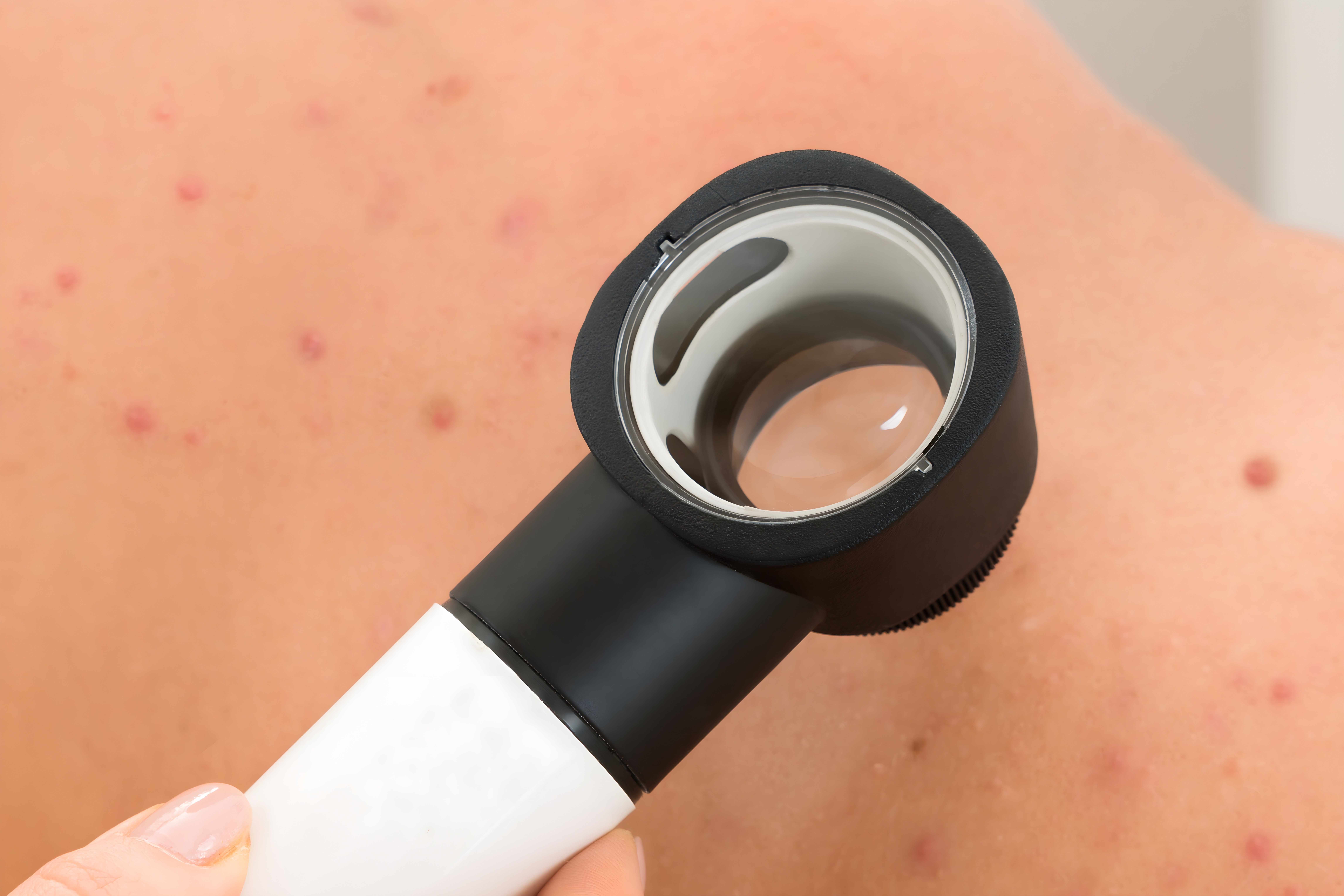
Any spot that is new, changing, bleeding, or failing to heal warrants evaluation by a board-certified dermatologist. You do not need to be certain it is a problem before making an appointment. A professional skin check is the only reliable way to assess suspicious lesions. AI image analysis might be a good start for some, but an in person exam with a dermatoscope is more precise. If you have been putting off a basal cell carcinoma evaluation, now is a good time to schedule one. Early evaluation is almost always better than waiting.
Does insurance typically cover basal cell carcinoma diagnosis and treatment?
Medical dermatology services, including evaluation, biopsy, and treatment of basal cell carcinoma, are covered by health insurance plans as medically necessary. Coverage details vary by plan and provider. Our team can help you understand what to expect. You can review insurance information relevant to our practice on our insurance resources page.
How can I prevent developing BCC?
Sunscreen, sun protective clothing and hats would be the 3 most valuable preventative tools.
You can also ask your dermatology provider about the roles of taking nicotinamide supplements, topical chemotherapy-field cancerization therapy, photodynamic therapy, and tretinoin.
Are HMGS dermatologists accepting new patients for skin cancer concerns in South Jersey?
Yes. HMGS Dermatologists serve patients across South Jersey from three locations in Marlton, Camden, and Hammonton. Whether you are coming in for a specific concern or an annual skin check, our board-certified dermatologists and APPs are available to evaluate your skin and discuss any findings with you. We welcome new patients and have treated families throughout Burlington, Camden, and Atlantic counties for generations. Call for details to get started.
If you are concerned about basal cell carcinoma, or if it has simply been too long since your last skin check, the right next step is a conversation with. HMGS Dermatology. . Call for details to schedule your evaluation today.
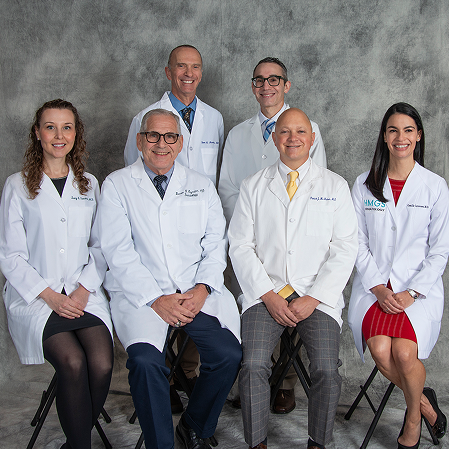
Board Certified Dermatologists and Partners
Dr. Warren Heymann, Dr. Steven Manders, Dr. Justin Green, Dr. Lacy Sommer, Dr. Patrick McMahon, and Dr. Camille Introcaso, MD
The partners of HMGS Dermatology represent some of the most highly trained, accomplished, and respected dermatologists in the region, bringing together decades of expertise across general, pediatric, surgical, and academic dermatology. With education and training from some of the nation’s top institutions—including the University of Pennsylvania, UCSF, Temple, and Rutgers—they are board-certified in multiple subspecialties such as dermatology, pediatric dermatology, and dermatopathology. Many serve as professors and program directors at Cooper Medical School of Rowan University, shaping the future of dermatology through teaching, research, and leadership. Collectively, they have held prestigious roles such as division heads, board directors, and presidents of dermatologic societies, while earning recognition through numerous “Top Doctor” awards and lifetime achievement honors. Whether advancing innovation in pediatric care, cutaneous oncology, or medical education, the HMGS partners are united by their commitment to excellence and providing the highest standard of compassionate, expert skin care to their patients.