


Hemangiomas are among the most common vascular birthmarks in infants and young children, yet they remain widely misunderstood by parents and patients alike. Whether you have noticed a small red patch or growth on your newborn, discovered a lesion on your own skin, or are simply doing your homework before a dermatology appointment, this page is designed to give you accurate, straightforward answers. Hemangiomas range from harmless superficial spots to complex lesions requiring urgent medical attention, and knowing the difference matters. If you have questions about a growth on your child or yourself, contact us for a consultation with one of our expert dermatologists in Marlton, Camden, or Hammonton, New Jersey.
What Are Hemangiomas and Why Do They Form?
Hemangiomas are benign tumors made up of a proliferation of blood vessels. The word “benign” is reassuring, but it does not mean hemangiomas are without potential complications. These growths are not the same as a bruise, broken capillary, or even a capillary malformation/port wine stain. They represent a genuine overgrowth of vascular tissue, and their behavior can be surprisingly unpredictable or linked to other malformations in the body.
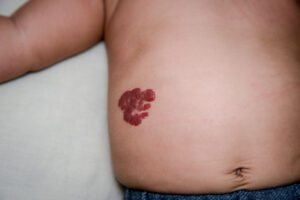
Infantile Hemangiomas
The most familiar type is the infantile hemangioma, sometimes called a “strawberry birthmark” because of its bright red, bumpy surface. These typically appear within the first few weeks of life and often go through a well-defined cycle: rapid growth through the first year, followed by a slower phase of spontaneous regression that may continue into early childhood. Research suggests that roughly 50 percent of infantile hemangiomas show significant fading by age five, and around 70 percent by age seven. However, individual results vary considerably depending on the size, depth, and location of the lesion.
Cherry Angiomas
Adults encounter hemangiomas too, most often in the form of “cherry angiomas”. These small, round, bright red dome-shaped growths are extremely common after age 30 and tend to increase in number with age. They are not dangerous, but patients often seek evaluation or removal for cosmetic reasons or because a new lesion has raised concern. Our page on cherry angiomas and hemangiomas covers adult presentations in greater detail. For adult cherry angiomas, genetics and age-related vascular changes are the most common explanation. Often patients exclaim, “my mom/dad has these”!
Hemangiomas That Go Beyond a Strawberry Birthmark: Recognizing Serious Presentations
Here is where a lot of parents and patients get a false sense of security. Not all hemangiomas quietly fade on their own. In certain locations and configurations, hemangiomas can pose real medical risks that require prompt evaluation and, in some cases, treatment.
Location-Dependent Complications
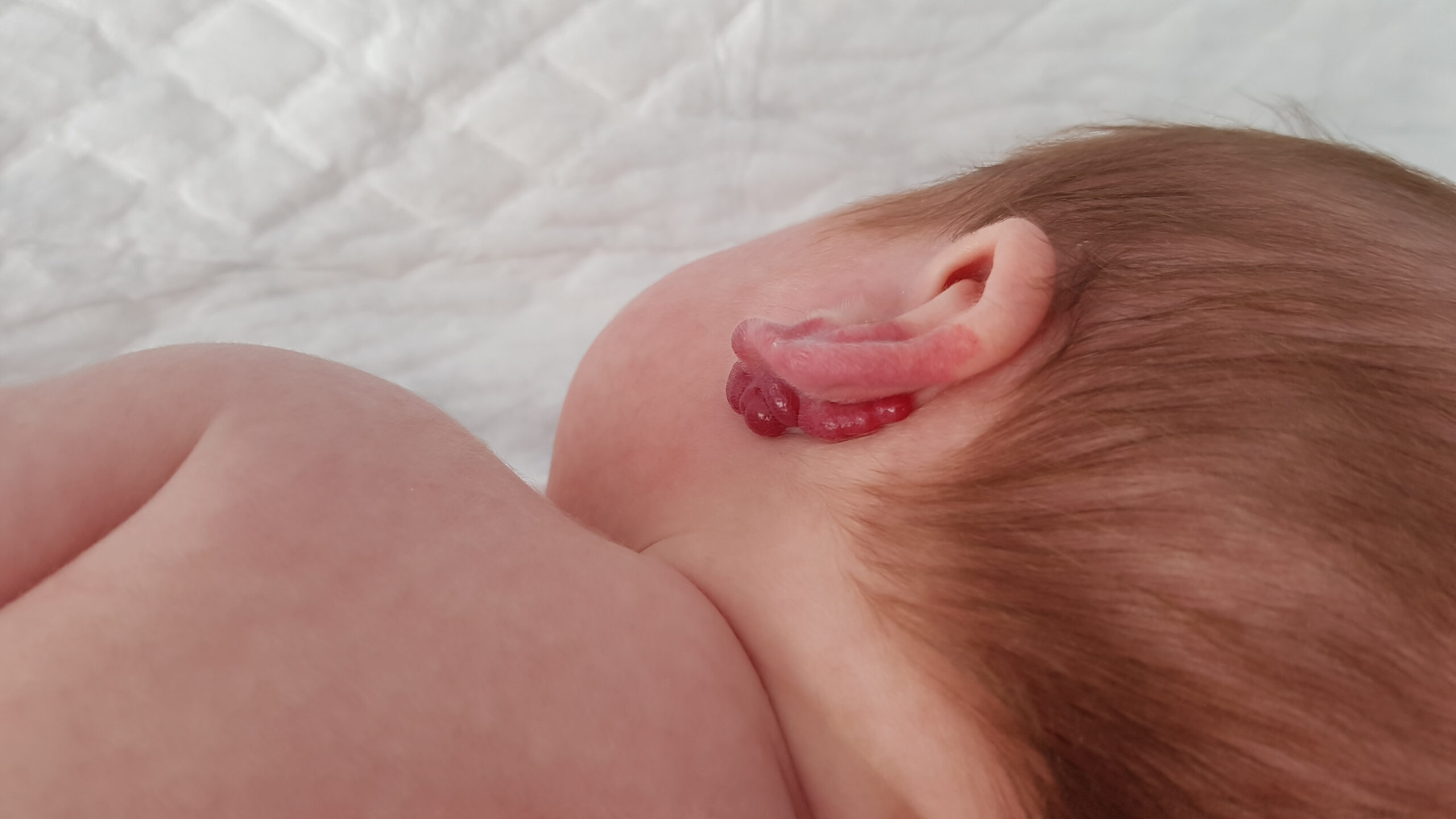
A hemangioma near the eye can interfere with normal vision development, potentially leading to amblyopia (“lazy eye”) if left untreated during a critical developmental window. Lesions around the mouth or throat may obstruct the airway and breathing. Hemangiomas on the nose and ear can distort cartilage as they grow and impact function. Those covering a large area of the face or scalp, particularly in a beard-like distribution, may be associated with PHACES syndrome, a condition involving structural abnormalities of the brain, heart, aorta, and other critical blood vessels. Plaque-like hemangiomas found lower body (back, groin, pelvis) can be associated with LUMBAR syndrome, a condition associated with complications of the spinal cord, kidney, anorectal and urogenital regions.Pediatric Dermatologists at HMGS have diagnosed and treated all of these hemangiomas syndromes (and more) over the past four decades.
Ulceration and Infection
Hemangiomas that grow rapidly can ulcerate, meaning the surface breaks down and becomes an open wound. Ulcerated hemangiomas can be painful and are prone to infection, scarring, and significant bleeding. Parents are sometimes surprised to learn that what looks like a small birthmark can become a genuine wound-care challenge. Early intervention with a board-certified pediatric dermatologist can reduce the risk of these complications considerably.
Internal Hemangiomas
Some hemangiomas are not visible on the skin at all. Hepatic hemangiomas, which develop in the liver, are among the most common benign liver tumors in adults and are typically discovered incidentally on imaging. In infants with multiple cutaneous hemangiomas, a workup for liver involvement may be appropriate. While most hepatic hemangiomas require no treatment, larger lesions carry a risk of rupture, which is a life-threatening emergency.

Diagnosing and Treating Hemangiomas: What to Expect
Most importantly, seek out a board-certified Pediatric Dermatologist. These experts will not just refer you to another group for care. HMGS Pediatric Dermatologists diagnose and treat the full range of hemangiomas from simple to the complicated.
Diagnosis usually begins with a clinical examination. In the hands of experienced pediatric dermatologists, most hemangiomas can be identified visually without invasive testing. When the diagnosis is uncertain, dermoscopy, ultrasound, or MRI imaging may be used to characterize the lesion more precisely. Our physicians, who also contribute to the field through peer-reviewed publications in dermatology, apply evidence-based diagnostic criteria to every case.
When Watchful Waiting Is Appropriate
For uncomplicated infantile hemangiomas in low-risk locations, a monitored observation approach is often reasonable. Parents should receive clear guidance on what changes to watch for and how frequently to follow up. Not every hemangioma needs immediate intervention, but “wait and see” should be an active, informed decision, not a default.
Medical Treatment Options
Propranolol, an oral beta-blocker, has been FDA-approved for the treatment of proliferating infantile hemangiomas requiring systemic therapy. It has become the standard of care for complicated or high-risk infantile hemangiomas, and the results in appropriate candidates can be significant. Topical timolol may help reduce the appearance of smaller, superficial lesions. Corticosteroids may be considered in certain situations as well. As with all treatments, candidacy and expected outcomes vary by individual, and a thorough consultation with a board-certified pediatric dermatologist is essential before starting any treatment plan. HMGS Dermatologists use all of these medications in appropriate cases.
Procedural Options
For residual skin changes after regression, or for adult cherry angiomas that a patient wishes to address, procedural options including pulse dye laser therapy (Vbeam) and electrocautery may be appropriate. These fall within the broader scope of cosmetic and medical dermatologic care available through our comprehensive dermatology services across South Jersey.
Why Choose HMGS Dermatologists in South Jersey?
South Jersey families have trusted HMGS Dermatologists for generations. Our practice includes eight board-certified dermatologists (four who are boarded in Pediatric Dermatology), and our physicians serve as professors and program director for the Dermatology Residency at Cooper Medical School of Rowan University. That means the doctors treating your family are also training the next generation of dermatologists. Dr. McMahon runs a weekly pediatric clinic at CMSRU in Camden where patients come from all over NJ and the tri-state region to seek expert care. Dr. McMahon is one of the few Dermatologists in the region to have completed both Pediatric and Dermatology residencies.
Our Top Docs have contributed to over 620 peer-reviewed publications, and in 2025, Dr. Heymann received the Master Dermatologist Award from the American Academy of Dermatology, one of the highest honors in the specialty. We have been recognized in Philadelphia Magazine, NJ Monthly, and SJ Magazine and featured in national outlets including AP News and Business Insider. With three locations across Burlington, Camden, and Atlantic counties, expert dermatologic care is always within reach. Whether your child has a hemangioma that needs monitoring or you have questions about an adult lesion, we are here to help.
Is a hemangioma the same as a birthmark?
Hemangiomas are a type of vascular birthmark, but not all birthmarks are hemangiomas. Birthmarks is a broad term that includes pigmented lesions such as congenital nevi and port wine stains, which are not hemangiomas. Hemangiomas specifically involve an abnormal growth of blood vessels. A board-certified dermatologist can distinguish between these types during a clinical examination and advise on whether monitoring or treatment is appropriate for your situation.
Will my child’s hemangioma go away on its own?
Many infantile hemangiomas do involute, or shrink, over time without treatment. Research suggests significant fading is common by school age, though individual results vary. However, hemangiomas in certain locations or those that are large, ulcerated, or growing rapidly may require treatment to prevent complications. A dermatologist can assess your child’s specific hemangioma and provide guidance on the most appropriate course of action. Do not assume all hemangiomas will resolve without evaluation.
How do I know if a hemangioma needs treatment?
Location, size, depth, rate of growth, and the presence of complications like ulceration all factor into this decision. Hemangiomas near the eyes, nose, ears, mouth, or airway deserve prompt professional evaluation. If a hemangioma is bleeding, developing an open sore, or growing rapidly in the first weeks of life, do not wait for a routine appointment. Contact us for a consultation so one of our board-certified pediatric dermatologists can assess the situation quickly.
Are hemangiomas hereditary?
A family history may slightly increase the likelihood of hemangiomas, but they are not strictly hereditary in a straightforward pattern. Research suggests that female sex, premature birth, low birth weight, and certain genetic factors may contribute to risk. Most cases occur without a clear family pattern. If you have questions about recurrence risk for future children, our physicians can provide informed guidance based on your family history during a consultation at any of our three South Jersey locations.
Can adults develop hemangiomas?
Yes. Cherry angiomas are the most common type of hemangioma in adults and become increasingly prevalent after age 30. They typically appear as small, bright red, dome-shaped spots on the trunk, arms, or shoulders and are generally harmless. That said, any new or changing skin lesion deserves professional evaluation, since other vascular or pigmented growths can look similar. Our team provides thorough mole checks and skin lesion evaluations for adult patients throughout South Jersey.
If you are researching hemangiomas for yourself or your child in South Jersey, you deserve accurate answers from a team of Top Docs with the credentials to back them up. Our board-certified dermatologists are ready to evaluate your concerns, explain your options clearly, and create a care plan that fits your situation. Call us or request a consultation online today.
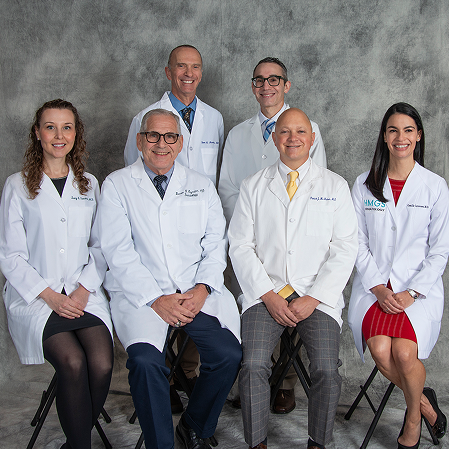
Board Certified Dermatologists and Partners
Dr. Warren Heymann, Dr. Steven Manders, Dr. Justin Green, Dr. Lacy Sommer, Dr. Patrick McMahon, and Dr. Camille Introcaso, MD
The partners of HMGS Dermatology represent some of the most highly trained, accomplished, and respected dermatologists in the region, bringing together decades of expertise across general, pediatric, surgical, and academic dermatology. With education and training from some of the nation’s top institutions—including the University of Pennsylvania, UCSF, Temple, and Rutgers—they are board-certified in multiple subspecialties such as dermatology, pediatric dermatology, and dermatopathology. Many serve as professors and program directors at Cooper Medical School of Rowan University, shaping the future of dermatology through teaching, research, and leadership. Collectively, they have held prestigious roles such as division heads, board directors, and presidents of dermatologic societies, while earning recognition through numerous “Top Doctor” awards and lifetime achievement honors. Whether advancing innovation in pediatric care, cutaneous oncology, or medical education, the HMGS partners are united by their commitment to excellence and providing the highest standard of compassionate, expert skin care to their patients.